Evaluating Floral Seamless Pattern Background 3 for Surface Design and Digital Projects
Selecting the right surface design asset requires balancing aesthetic appeal with technical versatility. Floral Seamless Pattern Background 3 represents a specific category of botanical illustration that bridges traditional artistry with modern digital utility. Unlike generic stock imagery, this pattern is engineered specifically for repetition, making it a functional tool for textile manufacturing, packaging design, and digital backdrops. When evaluating this resource against other market options, professionals must consider not only the visual style but also the file architecture, scalability, and intended end-use. Understanding the distinct characteristics of Floral Seamless Pattern Background 3 helps designers determine if it aligns with their current project requirements or if an alternative style would better serve their production goals.
Defining the Aesthetic and Technical Profile
Floral Seamless Pattern Background 3 is characterized by its balanced composition and repeat structure. In surface design, "seamless" is a technical specification rather than a descriptive adjective. It indicates that the motif tiles perfectly on both the horizontal and vertical axes without visible breaks or misalignment. This particular iteration typically features a moderate density of floral elements, avoiding the extreme minimalism of sparse line art and the visual chaos of hyper-dense baroque styles. This middle-ground complexity makes it highly adaptable for various scales, from small gift wrap prints to large-format wallpaper installations.
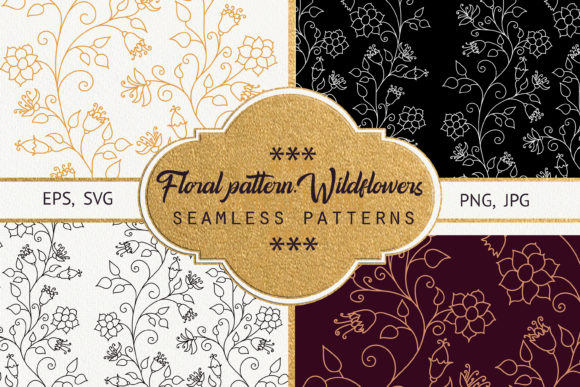
From a technical standpoint, the availability of multiple file formats is a critical differentiator. The inclusion of an .EPS file ensures that the design remains vector-based or high-resolution raster within a vector container. This allows surface designers to resize the pattern for industrial fabric printing without losing edge definition. Conversely, the JPEG and PNG files provide immediate usability for digital mockups, web backgrounds, and client presentations. The PNG format specifically offers transparency support, which is essential when layering Floral Seamless Pattern Background 3 over colored backgrounds or integrating it into composite designs where the base color needs to be adjustable.
Comparing Format Utility: Vector vs. Raster Workflows
When comparing Floral Seamless Pattern Background 3 to similar assets, the deciding factor often lies in the workflow compatibility. Many entry-level patterns are sold exclusively as flattened JPEGs. While sufficient for digital scrapbooking or low-resolution web use, flattened files present significant limitations for professional textile and print production. If a designer needs to change the colorway of a floral motif to match a specific Pantone reference for fabric dyeing, a raster-only file requires tedious masking and recoloring processes that can degrade image quality.
The .EPS component of Floral Seamless Pattern Background 3 addresses this limitation directly. It positions the asset as a production-ready resource rather than merely a decorative element. However, users should verify the internal structure of the EPS before purchase. Some EPS files are simply raster images embedded in a vector shell, which negates the scalability benefits. True vector EPS files allow for infinite scaling and effortless color separation. For designers working in fashion or home decor, confirming that Floral Seamless Pattern Background 3 offers editable paths is as important as the visual design itself. If the primary use case is strictly digital content creation, the high-resolution JPEG and PNG files may suffice, making the vector capabilities a secondary consideration.
Application Fit: Textile, Wallpaper, and Packaging
Different mediums impose unique constraints on pattern selection. Floral Seamless Pattern Background 3 is marketed for diverse applications, but its suitability varies by context. For fabric and textile design, the scale of the repeat is paramount. A pattern that looks elegant on a screen may become overwhelming when printed across yards of upholstery fabric, or conversely, lose detail when printed on lightweight silk. Designers must evaluate the physical repeat size (often measured in inches or centimeters) against the weight and drape of the target material. This pattern’s balanced density generally performs well on mid-weight cottons and linens used in apparel and soft furnishings.
In the realm of gift wrap and packaging, contrast and legibility take precedence. Packaging design often requires space for typography, branding, or product information. Floral Seamless Pattern Background 3 serves effectively as a backdrop because its organic forms create texture without competing aggressively with foreground text. Compared to geometric patterns, which can sometimes create optical illusions or moiré effects when folded, organic floral patterns tend to be more forgiving in three-dimensional applications. However, if the packaging requires high-contrast accessibility or bold graphic impact, a more stylized or abstract alternative might outperform a traditional floral arrangement.
For wallpaper and interior backdrops, the viewing distance changes the evaluation criteria. Wallcoverings are viewed from several feet away, meaning fine details in Floral Seamless Pattern Background 3 may blend into a general texture. This can be advantageous for creating subtle ambiance but disadvantageous if the goal is to showcase intricate botanical accuracy. Designers selecting this pattern for interiors should request or generate a full-scale test print to assess how the colors and details translate at architectural scale.
Strengths and Tradeoffs in Professional Use
No single pattern solves every design problem. Evaluating the tradeoffs of Floral Seamless Pattern Background 3 ensures realistic expectations.
- Versatility vs. Specificity: The balanced aesthetic makes this pattern safe for broad commercial appeal. However, projects requiring niche historical accuracy (e.g., Victorian reproduction) or avant-garde abstraction may find this design too generalized. It excels as a foundational layer but may lack the distinctiveness needed for luxury branding.
- File Flexibility vs. Learning Curve: While the .EPS file offers superior control, it requires proficiency in Adobe Illustrator or similar vector software. Designers accustomed solely to Photoshop or Canva may find the learning curve steep. In such cases, the included PNG/JPEG files provide a lower-barrier entry point, albeit with reduced editability.
- Seamless Integrity vs. Organic Variation: Digital seamless patterns are mathematically perfect. For some artisanal or handcrafted aesthetics, this perfection can feel sterile. If a project demands visible brushstrokes or irregular registration typical of block printing, a digitally generated seamless pattern like this one may require additional texturing or distressing to achieve the desired authentic look.
Decision Factors: When to Choose Alternatives
Recognizing when Floral Seamless Pattern Background 3 is not the right choice saves time and budget. Several scenarios warrant exploring alternatives:
- Large-Scale Mural Printing: If the intended application exceeds standard wallpaper widths, verify the native resolution. Even vector-based patterns can contain raster effects (like shadows or watercolor textures) that pixelate at massive scales. Dedicated mural assets with higher DPI specifications may be necessary.
- Dark Mode Digital Interfaces: Traditional floral patterns are often designed on light backgrounds. Using them in dark-mode UI/UX design requires inversion or heavy recoloring, which can invert the natural shading and make flowers look unnatural. Assets specifically designed for dark interfaces often have adjusted luminance values.
- Licensing Restrictions: File format does not dictate usage rights. Before integrating Floral Seamless Pattern Background 3 into merchandise for resale, verify the license terms. Some licenses cover personal use or limited-run prints but exclude mass-market textile manufacturing or NFT creation. Comparing licensing tiers across vendors is as crucial as comparing visual styles.
- Trend Sensitivity: Floral motifs cycle through trend phases. If the project has a long shelf life (e.g., permanent hotel interiors), ensure the specific rendering of Floral Seamless Pattern Background 3 avoids fleeting stylistic markers that will date the installation quickly. Timeless botanical illustrations generally offer better longevity than stylized, trend-driven interpretations.
Practical Evaluation Checklist
Before finalizing the selection of Floral Seamless Pattern Background 3, run through this practical assessment to confirm alignment with project parameters:
- Resolution Verification: Confirm the JPEG/PNG dimensions meet the minimum DPI requirements for your output method (300 DPI for print, 72-150 PPI for screens).
- Color Space Compatibility: Check if the files are RGB (digital) or CMYK (print). Converting between color spaces can shift floral hues significantly; starting with the correct profile prevents costly reprints.
- Repeat Size Measurement: Calculate how many repeats fit within your production width. Excessive cutting waste indicates poor scale matching.
- Editability Test: Open the .EPS file to confirm layers are organized and colors are separable before committing to bulk production.
Ultimately, Floral Seamless Pattern Background 3 offers a robust solution for designers seeking a versatile, multi-format botanical asset. Its value proposition lies in the combination of aesthetic balance and technical readiness across vector and raster workflows. By critically assessing the specific demands of fabric, packaging, or digital applications against the pattern’s inherent characteristics, professionals can make informed decisions that balance creative vision with production realities. Whether chosen for its immediate usability via PNG or its long-term adaptability via EPS, success depends on matching the asset’s capabilities to the project’s precise technical and aesthetic constraints.