Unlocking Creative Potential: A Comprehensive Guide to Red and Blue Floral Seamless Patterns
In the vast landscape of digital design and surface pattern creation, few elements possess the timeless versatility of floral motifs. Among these, red and blue floral seamless patterns occupy a unique niche, bridging the gap between traditional aesthetics and contemporary application. Whether you are a seasoned textile designer, a print-on-demand entrepreneur, or a hobbyist looking to elevate your digital scrapbooking, understanding the technical and artistic nuances of these patterns is essential. This guide explores the significance of this specific colorway, its practical applications in modern creative workflows, and the critical technical specifications that ensure professional results.
The Psychology and Versatility of Red and Blue Florals
To truly appreciate red and blue floral seamless patterns, one must first understand why this specific color combination resonates so deeply with audiences. Color theory suggests that red and blue are primary colors that sit on opposite ends of the temperature spectrum. Red evokes passion, energy, warmth, and urgency, while blue communicates calm, stability, trust, and coolness. When combined in a floral arrangement, they create a dynamic visual tension that is both stimulating and balanced.
This duality makes red and blue florals exceptionally versatile across different industries. In fashion, this palette can reference vintage Americana, classic French toile, or bold modern abstracts depending on the scale and style of the flower. In home decor, it transitions effortlessly from rustic farmhouse textiles to sophisticated upholstery. For digital creators, this high-contrast pairing ensures visibility and impact on screens, making it ideal for social media backgrounds, website headers, and digital stationery. Unlike monochromatic designs that may fade into the background, the interplay of warm and cool tones in these patterns commands attention without overwhelming the viewer.
Understanding Seamless Pattern Architecture
A common misunderstanding among beginners is assuming that any repeating image qualifies as a "seamless" pattern. True seamlessness is a technical achievement, not just a visual style. A seamless pattern is engineered so that the edges of the canvas align perfectly when tiled horizontally and vertically. There should be no visible breaks, mismatched lines, or abrupt color shifts where one tile ends and the next begins.
When working with red and blue floral seamless patterns, the complexity increases because organic shapes like petals and leaves often cross the boundary of the canvas. If a red rose is split between the left and right edges, the designer must ensure that the exact same portion of the rose appears on the opposite side at the precise coordinate. This mathematical precision is what allows the pattern to be extended infinitely across any surface area, whether it is a small business card or a massive roll of wallpaper. Understanding this architecture helps users appreciate the value of professionally prepared files and prevents frustration during the production process.
Technical Specifications: Why They Matter
For designers and businesses, the utility of a digital asset is defined by its technical specifications. When acquiring a collection of red and blue floral seamless patterns, specific parameters dictate how and where the files can be used. Let us break down the standard professional deliverables to understand their real-world implications.
Resolution and Pixel Dimensions
The industry standard for high-quality printable patterns is 300 DPI (Dots Per Inch). This resolution ensures that when the file is printed, the ink droplets are dense enough to create crisp, sharp edges without pixelation or blurring. A file dimension of 3600×3600 pixels at 300 DPI translates directly to a physical print size of 12″x12″. This 12-inch square is a crucial benchmark in the printing industry. It is large enough to serve as a substantial repeat unit for fabrics and wallpapers, yet manageable enough for digital devices to render without lag.
If you were to use a web-standard image (typically 72 DPI) for printing, a 3600-pixel image would result in a blurry 50-inch print. Conversely, using the correct 300 DPI specification guarantees that your 12″x12″ output retains the integrity of every brushstroke and petal detail. This distinction is vital for anyone selling physical products; customers expect gallery-quality prints, and meeting the 300 DPI threshold is non-negotiable for professional merchandise.
Color Mode: RGB vs. CMYK
You will typically receive these files in RGB color mode. This is an important distinction for users accustomed to print-only workflows. RGB (Red, Green, Blue) is an additive color model designed for light-emitting displays like monitors and phones. It offers a wider gamut of vibrant colors than CMYK (Cyan, Magenta, Yellow, Key/Black), which is subtractive and used for ink printing.
Receiving files in RGB provides maximum flexibility. Digital designers can use the files immediately for web and screen projects without conversion loss. For those intending to print, modern RIP (Raster Image Processor) software and professional printers handle RGB-to-CMYK conversion efficiently. Starting with RGB preserves the luminosity of the red and blue hues, whereas starting in CMYK can sometimes dull the vibrancy before the file even reaches the printer. However, users should always request a test print to verify color accuracy, as the bright blues and deep reds of RGB may shift slightly when translated to physical ink.
File Format and Quantity
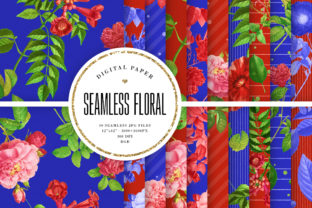
Receiving 10 seamless JPG files offers immediate usability. JPG is a universally compatible format that balances quality with file size, making it easy to upload to print-on-demand platforms, share with clients, or import into design software like Photoshop, Canva, or Illustrator. Having ten distinct variations in a single collection allows for cohesive branding. You might use a large-scale red floral for a duvet cover, a smaller blue geometric floral for matching pillowcases, and a blended tone-on-tone version for packaging. This variety enables creators to build entire product lines rather than isolated items, increasing perceived value and marketability.
Practical Applications in Modern Workflows
The relevance of these patterns extends far beyond simple decoration. In today’s gig economy and digital marketplace, red and blue floral seamless patterns serve as foundational assets for various business models.
- Print-on-Demand (POD): Entrepreneurs use these 12″x12″ tiles to create all-over print apparel, phone cases, and tote bags. The seamless nature ensures the design looks intentional and professional across curved or irregular surfaces.
- Digital Product Creation: Designers incorporate these patterns into digital planners, social media templates, and website themes. The RGB color mode ensures the florals look vibrant on iPad screens and desktop monitors.
- Textile and Surface Design: Professional designers use these high-resolution files as base layers, adding custom typography or logos on top to create proprietary branding materials or limited-edition fabric runs.
- Educational Resources: Teachers and educators utilize engaging floral backgrounds for worksheets, certificates, and classroom decor, leveraging the psychological balance of red and blue to maintain student focus while creating a welcoming environment.
Common Misconceptions and Best Practices
Despite the accessibility of digital assets, several misconceptions persist. One frequent error is assuming that "high resolution" applies universally. A file may be 3600×3600 pixels but only 72 DPI; while the pixel count is high, the metadata tells the printer to spread those pixels over a massive area, resulting in poor quality. Always verify both pixel dimensions and DPI settings before sending files to production.
Another assumption is that seamless patterns do not require layout consideration. Even though the pattern repeats infinitely, the placement of focal points matters. When designing a dress, for example, you must consider where the largest red flowers land relative to seams and darts. The 12″x12″ tile size gives you a predictable grid to plan around, but thoughtful placement distinguishes amateur work from professional design.
Finally, users often overlook licensing. Just because a file is technically perfect does not mean it is legally cleared for commercial use. Always verify that your acquisition includes the appropriate license for your intended application, whether personal, commercial, or extended commercial use.
Building a Broader Understanding
Mastering the use of red and blue floral seamless patterns is about more than just downloading files; it is about understanding the intersection of art, technology, and commerce. By grasping the technical requirements of 300 DPI and 3600×3600 pixel dimensions, respecting the characteristics of RGB color space, and appreciating the psychological impact of this classic colorway, creators can transform simple digital assets into compelling, market-ready products. Whether you are crafting a new fashion line, designing a digital brand identity, or simply exploring the joys of pattern making, these foundational concepts ensure your creative vision is realized with precision and professionalism.