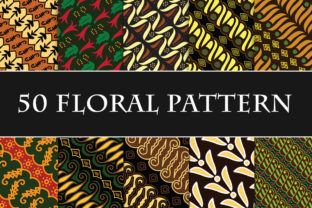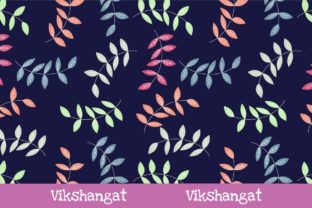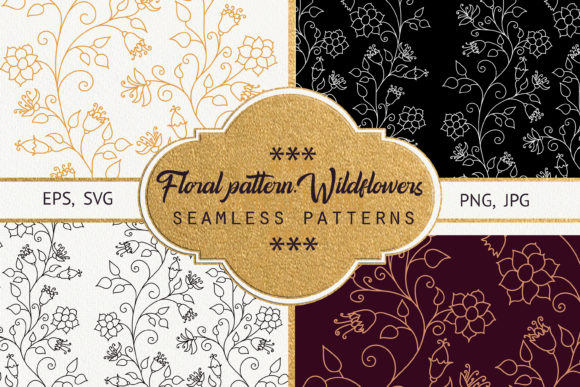
Floral Beautiful Wallpaper Pattern: Evaluating Vintage Vector Art for Fabric and Digital Design
Selecting the right surface design requires balancing aesthetic appeal with technical versatility. When evaluating a Floral Beautiful Wallpaper Pattern, particularly one rooted in vintage aesthetics, designers must consider more than just visual charm. The distinction between raster-based imagery and true vector art fundamentally alters how a pattern can be utilized across different media. A collection featuring 100 vector art pieces in a vintage style offers a specific set of advantages for professionals working in textile manufacturing, interior decoration, and digital product creation. Understanding the technical specifications and practical applications of these assets is essential for making an informed purchasing decision.
Defining the Vintage Vector Aesthetic in Surface Design
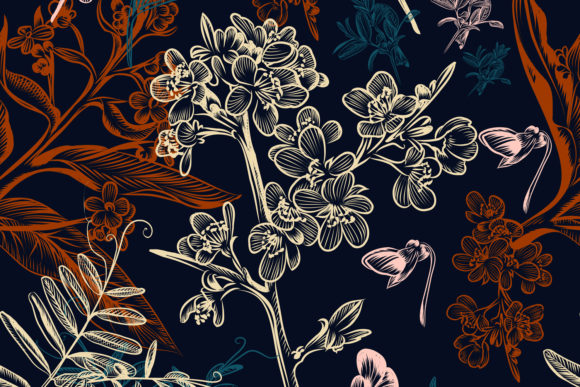
The term "vintage" in the context of floral patterns refers to a specific artistic lineage that prioritizes organic imperfection over digital precision. Unlike modern, geometric florals generated entirely within software, vintage-style vector art often originates from hand-drawn illustrations that have been digitized or created using brushes that mimic traditional media. This approach preserves the beautiful hand-drawn characteristics that give the Floral Beautiful Wallpaper Pattern its distinct warmth and tactile quality.
For fabric design specifically, this aesthetic serves a functional purpose beyond nostalgia. Textile printing relies heavily on repeat structures where slight variations in line weight and color saturation prevent the design from looking sterile or mass-produced. A high-quality vintage vector set captures the nuance of watercolor washes, ink bleeds, and pencil textures while maintaining the mathematical cleanliness required for seamless tiling. When comparing options, it is vital to verify that the "vintage" look is intrinsic to the vector paths themselves rather than a raster texture overlay. True vector vintage art allows for color separation and manipulation without degrading the underlying texture, whereas texture overlays often break apart when scaled or recolored.
Technical Scalability: Vector vs. Raster Alternatives
The primary decision factor when choosing between this type of resource and standard wallpaper downloads is scalability. Vector versions allow you infinite scaling while preserving the beautiful hand-drawn characteristics. This capability is not merely a convenience; it is a requirement for multi-format design workflows.
In a comparison against high-resolution raster files (such as PNG or TIFF), vectors offer superior flexibility for physical production. A 5000x5000 px JPEG preview included in this package serves as a reference, but the working files (AiCS2 and EPS10) contain mathematical path data. This means the same Floral Beautiful Wallpaper Pattern can be applied to a small garment label, a standard wall mural, or large-scale upholstery fabric without any loss of fidelity. Raster alternatives, even at high DPI, have a hard ceiling; enlarging them beyond their native resolution results in pixelation and blurring.
However, vectors do have tradeoffs. They cannot replicate the complex, chaotic blending of true wet-on-wet watercolor painting as perfectly as a high-resolution scan. If your project demands photographic realism or extreme painterly chaos that defies clean path definition, a raster alternative may be preferable. Yet, for commercial fabric design where clean edges and manageable file sizes are paramount, the vector format provides a necessary balance of artistic expression and production readiness.
Evaluating File Formats and Compatibility Standards
When assessing digital assets, file compatibility determines long-term utility. This resource includes three specific deliverables: one AiCS2 file, one EPS10 file, and one JPEG preview. Understanding what these formats imply for your workflow is crucial for evaluation.
- AiCS2 (Adobe Illustrator CS2): This is a legacy format dating back to 2005. While it ensures maximum backward compatibility for users with older software or automated RIP systems in print shops, it lacks support for modern features like multiple artboards, advanced gradients, or transparency effects. Users on current Creative Cloud versions will open this file without issue, but they should be aware that saving it back to CS2 may flatten newer effects.
- EPS10: Encapsulated PostScript version 10 is the industry standard for vector exchange. It is widely supported by non-Adobe software such as CorelDRAW, Affinity Designer, and Inkscape. For designers who do not use Adobe products, the EPS10 file is likely the most valuable asset in this bundle.
- JPEG Preview (5000x5000 px): This serves as a quick-reference catalog image. At 5000 pixels square, it is sufficiently large for digital mockups, web presentations, or client approvals, but it should never be used for final print production.
Designers requiring modern AI features or extensive layer organization may find the CS2 limitation restrictive. Conversely, those prioritizing universal compatibility and archival stability will view this format choice as a strength. Always verify your software’s ability to edit legacy vector files before committing to a purchase.
Volume and Variety: Assessing the 100-Piece Collection
The inclusion of 100 vector art pieces significantly shifts the value proposition compared to single-pattern purchases. For professionals, volume equates to efficiency. Having a cohesive library of vintage floral elements allows for rapid prototyping and mix-and-match customization without leaving the design environment.
When comparing this collection to smaller bundles or individual artworks, consider the consistency of style. A curated set of 100 items typically shares a unified color palette, line weight, and artistic voice. This coherence is difficult to achieve when sourcing individual vintage vectors from disparate creators over time. For fabric designers creating coordinated collections (e.g., a main print, a blender, and a coordinate), having immediate access to stylistically matched assets reduces development time. However, if your project requires only one specific motif, a larger collection may represent unnecessary overhead. Evaluate whether your upcoming project roadmap justifies the acquisition of a comprehensive library versus a targeted single asset.
Practical Applications and Best-Fit Scenarios
Determining when a Floral Beautiful Wallpaper Pattern in vector format is the correct choice depends largely on the end-use application. The strengths of this asset class align best with specific professional scenarios.
Ideal Use Cases:
- Textile and Apparel Manufacturing: Where repeat sizing varies by product category (scarves vs. dresses vs. curtains).
- Custom Wallpaper Production: Where wall dimensions dictate custom scaling that exceeds standard raster resolutions.
- Stationery and Packaging: Where the same motif must appear on business cards and large shipping boxes.
- Licensing and POD: Where platforms require multiple aspect ratios and resolutions from a single source file.
Situations Requiring Alternatives:
- Web-Only Backgrounds: If the pattern will never be printed, a lightweight CSS-generated pattern or optimized SVG/WebP may be more performant than editing raw AI/EPS files.
- Photorealistic Composites: If integrating with photography where vector sharpness looks artificial against grainy film stock.
- One-Off Digital Art: If no future resizing or recoloring is anticipated, a pre-rendered high-res raster may save setup time.
Important Considerations Regarding Mockups and Support
A critical detail in evaluating this resource is the explicit note that mockups are not included in the download. Many marketplace listings feature stylized presentation images showing the pattern draped over furniture or framed on walls. These are marketing visuals intended to demonstrate potential, not deliverable assets. Buyers must possess their own mockup templates or 3D rendering capabilities to visualize the Floral Beautiful Wallpaper Pattern in context. Failing to account for this can lead to disappointment upon delivery.
Additionally, the creator emphasizes personal involvement and offers direct assistance. In an era of automated marketplaces and anonymous asset generation, access to the original artist adds significant value. Technical issues with legacy file formats, questions about color separation for screen printing, or requests for usage clarification can be resolved directly. This level of support mitigates some of the risks associated with older file standards and ensures the asset remains usable regardless of software updates.
Making the Final Decision
Choosing a vintage vector floral collection involves weighing artistic integrity against technical constraints. The Floral Beautiful Wallpaper Pattern described here occupies a niche suited for practitioners who value editability and scale over plug-and-play simplicity. The combination of hand-drawn aesthetics with rigorous vector construction addresses the core tension in digital surface design: maintaining human touch in a scalable medium.
If your workflow demands frequent resizing, color adaptation, and cross-platform compatibility, and if you appreciate the specific warmth of vintage illustration, this format is likely a strong fit. Conversely, if you require modern AI-exclusive features or photorealistic textures, you should continue exploring alternatives. Ultimately, the joy of creation mentioned by the artist translates into a product designed with care, but its utility is determined by how well its technical specifications align with your production pipeline. Evaluate your current and future project needs against the CS2/EPS10 foundation to ensure this investment supports your creative objectives effectively.